
Why imagination-led environments are reshaping play space design.
If you've been in the play industry for any length of time, you will already be aware of this shift. Industry professionals, educators, and researchers have been championing for more open-ended play spaces for many years. But what feels different right now isn’t the argument for the need to create these spaces, but the speed at which this trend is being adopted.
Parks, schools, early learning centres, and even backyard play equipment are all moving in the same direction to offer less structure, more nature, and include spaces where the child's imagination does more work than the equipment ever could.
Moving past the single-use playground
There's nothing wrong with a good slide, classic swing set or a well-designed climbing frame. These elements still matter, and they're not going anywhere. But if that's all a playground offers, it can end up with a space that offers play that is quick, predictable, and easily exhausted. Kids figure it out fast - and then they're done.
The industry has been grappling with this for years. Open-ended environments, the kind without a single "correct" use, offer something that traditional elements can't on their own. They invite kids to interpret, adapt, and invent, and research shows these play environments are used for longer.
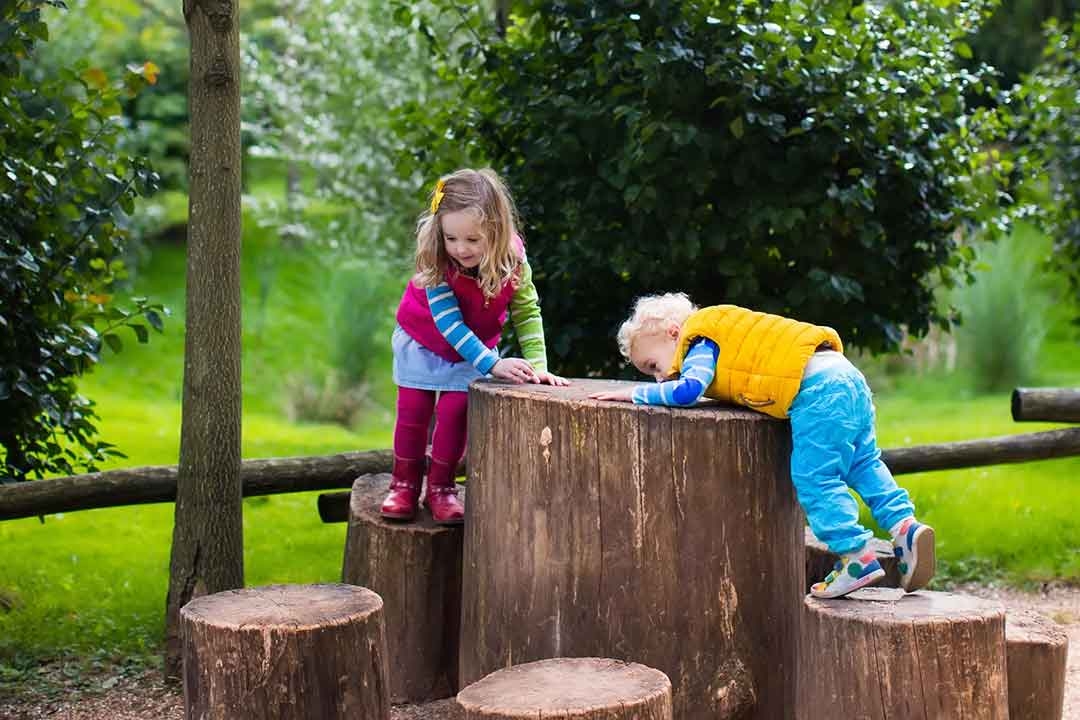
A log isn't just a log. It can be many things. Maybe one day it’s a balance beam, the next day it's part of a pirate ship, and the next minute it's a boundary marker. Rocks can become a pathway, puzzle, water play area, or a multitude of other things. Water, sand, and loose materials add a layer of variability that no fixed structure can replicate - and variability is exactly what keeps kids coming back.
These ideas have been incorporated into playground designs for years, but where previously these may have been on the periphery or a nice add-on, now they are becoming the centrepiece of many projects.
Why nature keeps leading the way
Natural materials don't come with instructions, and that's the point. They're irregular, tactile, and responsive to their environment - they change with the seasons, behave differently depending on how they're used, and don't have a "done" state.
Clients are now requesting that nature-based elements be incorporated into designs, and this trend is being seen both in commercial spaces, public spaces, and even in residential backyards.
Spaces that hold a child's attention are the goal. Nature-based design just happens to be particularly good at delivering that.
A signal worth paying attention to
Something interesting has been happening in private residential projects and smaller-scale installations, where families are making decisions largely on instinct rather than design frameworks
People are increasingly choosing open-ended play equipment that allows for imaginative play, and as an example of this, an Australian outdoor play retailer, The Best Backyard, recently reported an increase in the sale of mud kitchens, cubby houses, sand and water toys, and nature-inspired playgrounds, alongside a decline in the sale of more traditional swing sets, climbing frames and slides.
What you actually see when you watch kids play
Theory aside, the most convincing evidence for all of this is straightforward observation.
In highly structured environments, play tends to follow a predictable arc. Kids cycle through the equipment, repeat what they've already figured out, and move on. In more open-ended, nature-rich spaces, something different happens. Play stretches out. It gets more social, more imaginative, more layered. The same space gets used in completely different ways - by different children, yes, but also by the same child on different days. The research also shows that nature-based play can promote development and a child’s wellbeing, which is another reason many schools and pre-schools are moving in this direction.
Families might not be using the same phrases as playground professionals might, and they don’t talk specifically about open-ended play, for example, but the trends show that families' purchasing decisions are moving in this direction.
This seems to align with what is already happening in parks, schools, and early learning environments, and points to the fact that outdoor play spaces work better when they leave room for the child to decide how to interact.
What this means for how we design
The practical question this raises isn't really "what should we include?" It's more like: how much are we willing to leave open?
If a space can't fully anticipate how it'll be used - and the best ones can't - then good design starts to look less like directing outcomes and more like creating conditions. That affects material selection (texture, variation, durability), spatial planning (room for movement in multiple forms), and the overall philosophy of a project.
Sometimes it also means pulling back. Resisting the urge to fill every corner. Trusting that an open patch of ground, a pile of loose materials, or an irregular landform will do more than another fixed element would.
An evolution, not a moment
Calling this a trend doesn't quite do it justice. Nature-based, open-ended play isn't new thinking that suddenly caught on - it's thinking that's been building for years and is now, finally, finding its footing across the industry.
Research, design practice, and the choices real families are making when nobody's watching are all pointing in the same direction. Play isn't defined by equipment. It's defined by the relationship between a child and their environment.
The most interesting play spaces being built right now understand that. And they're designed not just around what gets built - but around what gets left open.


Comments
Add new comment