
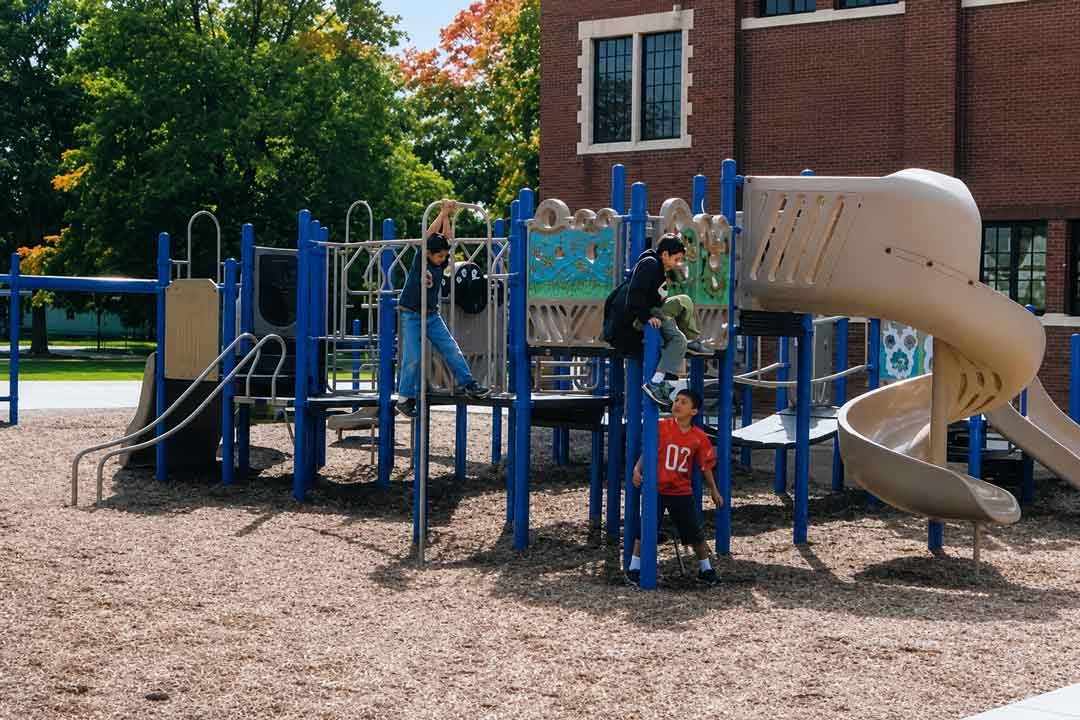
Most professionals involved in the care and education of children recognize the value and critical importance of outdoor play. Building strength, gaining courage and confidence, socializing, taking risks, improving coordination, exercising, releasing energy, and simply having fun are all attributes that a well-planned and equipped playground can provide for a child.
But even if the decision to build a playground is an easy one to make, the decisions that follow are often much more challenging. The planning of a new or renovated playground can be especially difficult if space is limited or budgets are tight. Fortunately, many options are available for even the most restricted of sites, and for conservative budgets as well, options that can clearly add up to a safe and successful playground environment.
Evaluating Options For Small Playground Sites
Many organizations that sponsor daycare or child education programs today are facing constraints as they move forward with the development of a playground. Churches, daycare centers, HeadStart programs, and schools in urban or older, dense suburban areas may lack ample space in which to construct a multifaceted play area with swings, climbing components, paved surfaces for basketball and other games, playing fields, and a variety of smaller components such as teeters and spring rockers.
In addition, many school districts with multiple playground sites on older school grounds may find themselves faced with a comprehensive renovation program in order to upgrade play facilities and improve safety. In such cases, maintaining a moderate budget for each site may be critical to implementing a district- wide improvement program.
Despite these challenges, a number of options are available. It is important for each community or sponsoring organization to explore its own program priorities, keeping in mind such issues as safety, including the appropriate surfacing and buffer zone around each component; ease of supervision; accessibility; and the inclusion of age-appropriate play activities.
Many education and playground experts recommend forming a committee to focus specifically on the development of the playground and what it should include. In New Hanover County Schools in Wilmington, North Carolina, for example, a broad-based committee met several times to consider how to implement an extensive improvement program for all 23 of the district's elementary school playgrounds.
According to Bill Hance, assistant superintendent of planning, technology, and operations, the 17-member committee included principals and other administrators, P.E. teachers, physical therapists, parents, a representative from the Exceptional Children's Department, the director of maintenance, the director of facility planning, the executive director of elementary education, and the director of safety.
"Our committee learned quickly that planning playgrounds can be complicated-there are a lot of considerations," says Hance. "Our goal for the process was to develop standards for all of our playgrounds and implement improvements according to those standards at all of the sites. We wanted to be able to work from a consistent set of criteria and specifications."
A professional playground safety audit for each site indicated the need to remove components that could potentially be hazardous or that were in poor condition. The committee then held a series of meetings with a neutral facilitator to develop a set of playground standards for the school district.
According to Hance, the budget was introduced midway through the process.
"We wanted the group to think freely about what they envisioned, and to share what they believed benefits the students most," Hance said. "Our consultant helped us to understand the play value of each of the pieces and which components tend to be most popular. Once we had a clearer idea of priorities, we introduced the budget. We couldn't accomplish everything we wanted, and some pieces had to be held for later phases, but everyone agreed on what should be included in the initial phase."
The New Hanover County Schools committee opted to focus on its lower elementary school playgrounds first. They determined that, allowing for current budget limitations, each playground should have a certain number of things. Among the necessities were appropriate, safe surfacing, a composite structure that features a variety of activities, and a swing set. Professional installation and borders for the play area were also important. Other components, such as teeters, balance beams, monkey bars, etc., were held for later phases; the committee anticipated that the PTAs might be able to assist with fundraising to support these additional items.
"Ideally, we would have liked to have had rubber surfacing for the playgrounds, but we couldn't accomplish that within the budget," says Hance. "We opted for the wood fiber mulch. The borders for the mulch were an expensive item, but we saved money by combining the bid package for all of the playgrounds, and by obtaining a number of competitive bids."
With New Hanover County Schools now well into the implementation process for its playground improvement program, Hance believes the process they followed has worked well. "My advice is to establish a playground committee, develop standards, and then begin implementation. Keep room in the budget for professional installation. And if you're doing a playground upgrade, don't take the old equipment out until you're ready to install the new pieces, unless the existing pieces are unsafe. People have a lot of questions when you take away equipment and don't replace it right away."
Basic Equipment for the Small Budget
In selecting new play equipment, look for certification by IPEMA, and choose well-known, insured manufacturers that have been in business under the same name for several years. Ask for documented warranty information and plan for replacement of equipment every 10-15 years.
Review the maximum number and age of users at each play area. Choose components that maximize a moderate budget, without requiring a lot of space. Manufacturers can provide an estimate of the carrying capacity or number of children each piece of equipment can safely accommodate. Ask manufacturers to review equipment selection to ensure that accessibility requirements are being met in the appropriate number of elevated and ground components.
Options include:
- Composite structures (featuring a mix of climbing, balancing, overhead, sliding, and play panel elements)
- Track rides (most appropriate for the upper elementary ages in a location that will discourage running through the path of the ride)
- Spring riders/teeters (for younger children)
- Sandboxes or sand tables (for younger children)
- Tables with fixed benches
- Painted hard surface play areas and courts
- Swings (although they provide the unique experience of "flying" in their forward and back motion, they do require a lot of room and may not be appropriate in the smallest of playgrounds- allow for a use zone of at least twice the height of the swing beam and 6 feet around each post)
- Additional climbing elements, such as climbing walls and challenge ladders, for older children
Maximizing a Small Playground Site
Lincoln Elementary School in LaPorte, Ind., also upgraded its playground site. The overall school site is relatively small at only 3.7 acres, and its 24,600 square-foot playground had several outdated play components. The area had also suffered from extensive vandalism, including repeated theft of the basketball hoops.
The new playground offers a mix of play activities for the elementary students, including composite structures, a track ride, and swings.
"Our site is landlocked, so the playground had to be compact and simple," says Wendell Tarnow, principal of Lincoln Elementary School. "Our new playground is not elaborate, but it's nice and safe, and the kids love it."
Tarnow recommends that if site size and budget parameters are limited, composite structures are very popular. "Do as much as you can with climbing elements," he advises. "They don't take up a lot of room, and the kids love to climb."
He also recommends placing tables with fixed benches in or near the playground area. "We have six tables now, and they are always filled with students," he says. "The kids take their books out there and read, trade baseball and Pokémon cards, and play games. The parents like them, too. The tables are a great investment."
The limited site does not allow for the playgrounds for the school's younger and older students to be separated by distance, so the two areas are located together and are divided by low shrubs and trees that permit ease of supervision on both sides. A hardwood fiber mulch, which meets accessibility guidelines, was chosen as the surface.
A blacktop area with painted games is also an important part of Lincoln Elementary School's playground, and the basketball hoops are still there. Vandalism, however, is no longer a problem. Although the school opted to install hoops that could easily be removed and brought in for safekeeping each evening, there have been no incidences of vandalism since the playground improvement was completed. After a few days, the school began leaving the hoops out, and they've remained in place.
Start Simple and Build
Extremely small sites and budgets call for composite structures that maximize opportunities for varied play activities. With shared posts and overlapping use zones, composite structures can accommodate more children at one time in the same amount of space as compared to several independent pieces of equipment. Most offer a variety of climbing activities; sliding; changes in scale that allow a child to view surroundings from above, below, and under; balancing; places to jump off; and semi-enclosed spaces. Composite play structures can be developed to meet a particular theme and can include features that follow the educational program, such as talk tubes and play panels.
The composite structures may become the centerpiece of a playground, with smaller, independent components placed nearby. At Avon High School in Avon, Ind., for example, a composite structure is featured in the school's 4,500-square-foot playground: The playground, which is used for daycare and to support the school's early childhood education program, also includes a four-seat teeter. A teeter still allows for a rocking motion and can be used in place of a swing set on tight sites.
"Our playground is very versatile," says Phyllis Dingman, who teaches child development and parenting classes at Avon High School. "The children enjoy the physical activities of climbing, sliding, and swinging on the slide bars, crawling through the tunnel, and driving the play gears of our composite structure. They seem to love the view from atop the slide and enjoy a quick peek as they hide from sight in the tunnels. The lower-level and enclosed slide is especially good for toddlers."
"Our playground offers four different surfaces. We have a rubber tile surface made of recycled tires under the climbing structure, a hardwood fiber surface similar to mulch around the teeter and sandbox, an asphalt surface for riding toys, and a concrete sidewalk and patio area. The hard surfaces are great for using our riding toys. Our playground gets a lot of use."
Many playgrounds are designed to be built in phases. The use zone for each future piece of equipment should be considered before locating the play area and establishing permanent edging around the resilient surfacing. PVC "timber" edging held in place with driven rebar is not the most permanent solution for edging in areas of the country that experience freezing temperatures, but it can be especially useful where budgets are tight and to allow for future expansion of soft-surface play areas.
Choose play equipment that offers a variety of play opportunities and challenge levels to provide children with "new frontiers" that will challenge their abilities. When planning for equipment with moving parts, such as swings, whirls, and track rides, remember to locate these items at the outside perimeter of the play area. On tight sites, however, this is not always possible. Try using plant materials, fences, or walls to separate these active use areas and direct traffic patterns of children to safely approach the equipment.
Tables and benches are perfect for quiet reading or small-group socializing, and double as outdoor classroom space. Games can also be created through creative patterning and illustrations on paved surfaces. It is possible to make "dual-use" of pavement in school settings by painting games on the bus/event parking lots if they can be blocked off from all traffic during the school day. Consider raised platforms or stepped seating to produce a "stage" or amphitheater for creative play. The play area setting does not have to simply be a collection of manufactured play equipment. Sand, water, or gardening areas are wonderful options for manipulative play. Other natural features, such as berms, rocks, and trees, can provide enclosure as well as climbing, rolling, and running experiences.
Regardless of which items are ultimately included, the most important decision is to move forward with a new or upgraded playground, regardless of how small the budget or the site might be. According to Tarnow at Lincoln Elementary School, "Kids need playgroundsthey need something to do, such as running, climbing, and getting exercise. I imagine we'd have a lot more discipline problems if it weren't for our playground."



Comments
Add new comment